Slash Your Electric Bill With Solar Panels
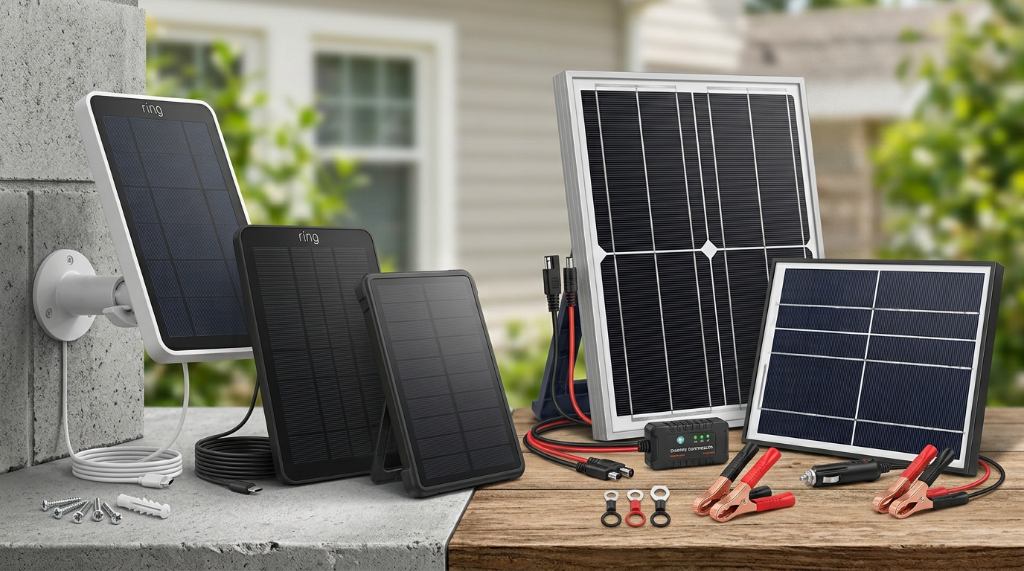
Solar Panel owners know the drill: you climb up, pull the battery, carry it inside, charge it for hours, then haul it back out. It gets old fast. A dedicated solar panel changes that whole routine by trickling power straight into your Ring or security camera so the battery stays topped off and you barely think about it again.
I have spent quite a bit of time researching how these panels perform in real weather and which ones actually survive the seasons.
I have dug through manufacturer datasheets, energy conversion specs, and hundreds of verified buyer reports to separate the genuine time-savers from the ones that barely keep a camera alive for an extra day. Here is what I found after comparing the top performers side by side.
Comparison Chart of Solar Panel
| Product | Details | Rating | Buy |
|---|---|---|---|
|
Editor’s Choice
 |
Ring Solar Panel (2nd Generation) |
★★★★☆4.8/5
|
|
|
Top Pick
 |
Solar Panel for Ring Camera, |
★★★★☆4.5/5
|
|
|
Best Budget
 |
SOLPERK Solar Panel Kit 20W |
★★★★☆4.7/5
|
|
|
|
★★★★☆4.4/5
|
||
|
|
★★★★☆4.3/5
|


List of Top 5 Best Solar Panel
These are the panels that consistently show up in user reviews as reliable, weather-resistant, and actually capable of keeping a camera topped off. I have focused on real-world performance, build quality, and how easy each one is to install.
Below are the list of products:
1. Ring Solar Panel (2nd Generation)
This is the official first-party option from Ring, designed specifically for the company’s own camera lineup. If you want guaranteed compatibility and a clean install, this panel is the safest bet you can make.
Highlights
- Plug and play design: The cable is designed with a built-in connector that snaps directly into the charging port of compatible Ring cameras. No adapters, no fiddling with weatherproof caps.
- 4W output: It outputs 4W of power, which is generally enough to keep a Stick Up Cam or Spotlight Cam battery topped off in normal daylight conditions.
- 16.4-foot cable: The extra-long cable gives you serious flexibility for positioning the panel in a sunny spot while the camera stays in the best security location.
- Weather-resistant build: It holds an IPX5 water resistance rating, meaning it can handle rain and snow without issues. This matters because the panel lives outside year-round.
Watch out for
The main catch is that it only works with Ring cameras that have the proper connector. Third-party general-use panels are more universal, but this one is strictly for the Ring ecosystem.
Also, some buyers note that mounting hardware is limited to the included bracket. If you need to angle it perfectly on a tricky roofline, you might need to buy an adjustable mount separately.
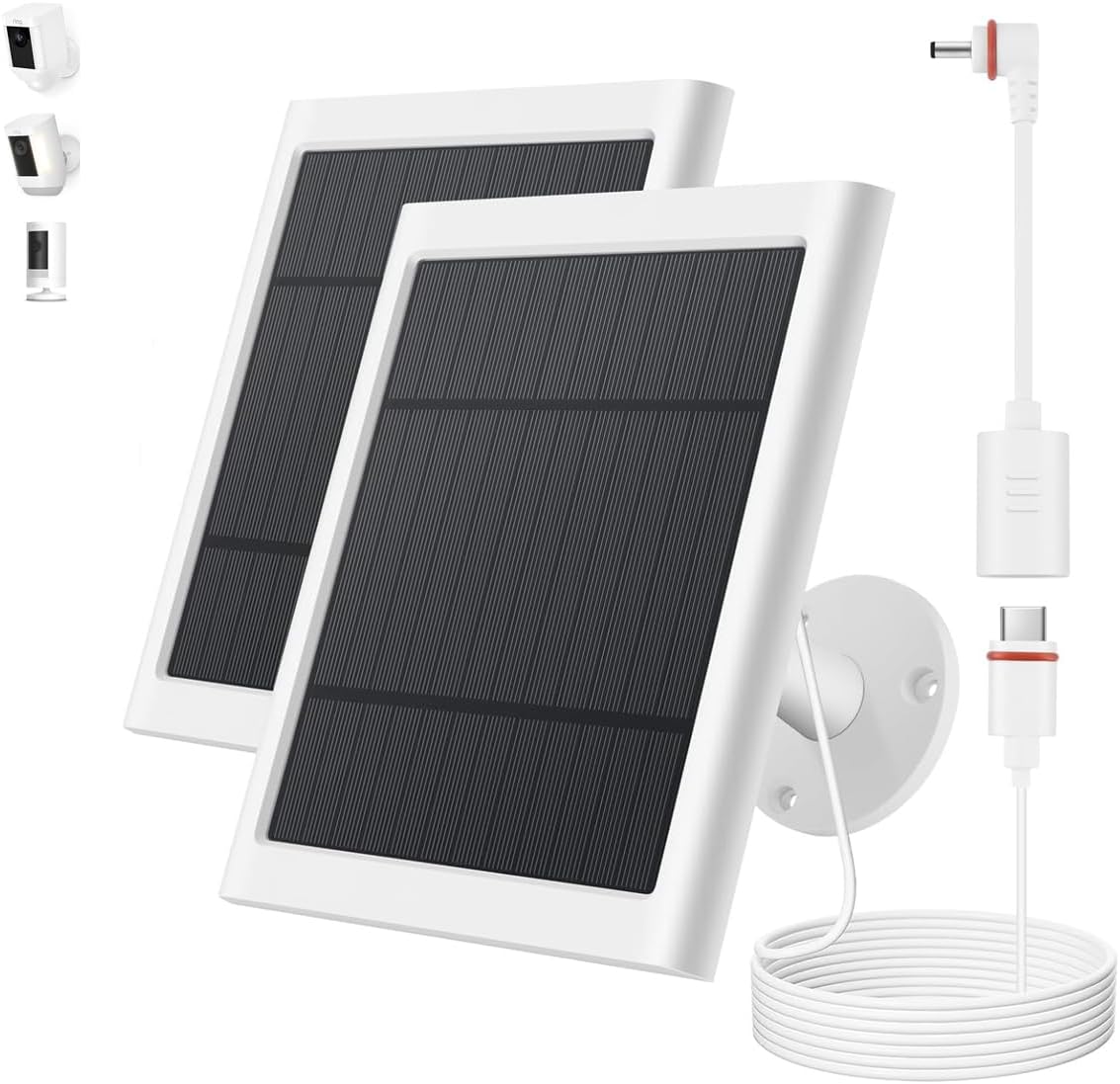
2. Solar Panel for Ring Camera,
This two-pack is a fantastic value if you have multiple cameras or if you want a spare panel on hand. The 10-foot cable and dual connection options make it a flexible alternative to the official Ring panel.
Highlights
- Two panels, one box: You get two complete 4W panels, which is the most cost-effective way to keep a pair of Stick Up Cams or Spotlight Cams charged.
- Versatile connector kit: It includes both USB-C and barrel plug adapters. This means it works with newer Ring cameras that use USB-C and older models or other brands like Reolink Argus Pro.
- 10FT cable: The cable length is workable for most eave and soffit installations without being so long that it becomes a tangled mess.
- IP65 weatherproofing: This rating means it is effectively sealed against dust and low-pressure water jets, so it holds up well in downpours.
Watch out for
A handful of buyers mention that the plastic mounting bracket feels less premium than the official Ring mount. It is sturdy enough for most homes, but the hardware is noticeably simpler.
Additionally, the 4W output is identical to the official Ring panel, so don’t expect a massive charging speed boost. This is about value and versatility, not raw power.
3. SOLPERK Solar Panel Kit 20W
This one is a completely different beast. It is a 20W panel designed for 12V batteries, so it is not for Ring cameras. It is for people who want to maintain a car battery, RV battery, boat battery, or other deep-cycle setups with a robust solar trickle charge.
Highlights
- Built-in charge controller: The kit includes a PWM charge controller that prevents overcharging, reverse current at night, and short circuits. This is a huge safety feature for battery longevity.
- 20W power output: With 20W of output, this panel can actually recharge a depleted car battery over a couple of sunny days, not just maintain it.
- Versatile mounting: It comes with long cable leads and pre-drilled holes, so you can ground-mount it or fasten it to an RV roof with simple hardware.
- Durable frame: The aluminum frame is rigid and handles wind loads much better than the flimsy plastic panels used for security cameras.
Watch out for
This panel is not plug-and-play for a camera. You need to understand basic DC wiring to connect the alligator clips or eyelet terminals properly.
The physical footprint is larger than you might expect. At 20W, this is a substantial panel that measures over a foot wide, so it looks like a serious piece of equipment, not a discreet accessory.
4. POWOXI 7.5W 12V Solar Battery Charger
This is a compact and simple trickle charger for 12V lead-acid batteries. It is ideal for cars, motorcycles, tractors, and lawnmowers that sit idle for long stretches, especially in the winter.
Highlights
- Simple clamp connection: It has battery clamps that connect directly to the battery terminals, so there is zero wiring involved. Anyone can install this.
- Smart diode protection: A built-in blocking diode prevents the battery from discharging back into the panel at night, which is a common flaw in cheap solar chargers.
- Flexible mounting: The panel is semi-flexible, which allows you to lay it on a curved dashboard or mount it to a cargo trailer roof.
- 7.5W output: This is a solid middle ground for maintaining a battery without being too bulky or powerful for small engines.
Watch out for
It only works on 12V systems. If you are trying to maintain a 6V motorcycle battery, you need an entirely different charger.
Also, 7.5W is only a maintenance charge. If your car battery is completely dead, this panel will take several days of full sun to bring it back to a starting charge.
This is the compact sibling to the main Ring panel. It is lighter and smaller, which makes it a great option for Stick Up Cams that are mounted in tight corners or under decking where space is limited.
5. Ring Small Solar Panel
Highlights
- Small footprint: The 1.9W panel is physically smaller, making it less obtrusive on a front porch or beside a door.
- Direct compatibilit: Just like the larger official panel, it connects directly to the charging port of Ring Stick Up Cams and Spotlight Cams without any adapter hassle.
- Weather-ready: It shares the same durable weatherproofing characteristics as the bigger Ring panel, so it stands up to rain and frost.
Watch out for
At 1.9W, this panel is half the output of the 2nd Gen model. It will slow down battery drain, but in overcast or high-traffic areas (where the camera wakes often), it may only extend battery life instead of fully maintaining it.
Quick recap
If you want the absolute safest bet for a Ring camera, the Ring Solar Panel (2nd Generation) is the Editor’s Choice. It is purpose-built, offers the best cable length, and guarantees a perfect waterproof connection with your Stick Up Cam or Spotlight Cam. It just works.
For the best value, the Solar Panel for Ring Camera, 2-Pack is the Top Pick. You get two panels with universal connectors for roughly the same price as one official panel, making it the smart choice for multi-camera homes. The SOLPERK Solar Panel Kit 20W takes the Best Budget slot for an entirely different use case.
If you need to maintain a 12V car, RV, or boat battery, that kit gives you the controller, power, and durability you need without breaking the bank.
Affiliate disclosure: This post contains affiliate links. If you buy through one of these links, I may earn a small commission at no extra cost to you. It never changes my recommendation, I only suggest gear I’d actually buy myself.
How to Match a Solar Panel to Your Camera
Before you buy anything, the most important step is figuring out what voltage system you are working with. A security camera panel outputs 5V via USB or a proprietary connector. A battery maintainer outputs 12V for automotive and deep-cycle use.
These two categories are not interchangeable, so grab the wrong one and you will be sending it back.
For Ring cameras specifically, you need a 4W panel (or the smaller 1.9W) designed with the proprietary barrel plug. If you have a Reolink or other IP camera, look for one with a USB-C adapter included, like the two-pack above.
What Is a Monocrystalline Panel?
A monocrystalline solar panel is a type of photovoltaic (PV) panel made from single-crystal silicon cells. It is the most efficient and space-saving technology on the consumer market, usually converting 18% to 22% of sunlight into electricity. That efficiency matters because it means you get more wattage from a smaller surface area.
In the context of security cameras, monocrystalline cells are standard. They also handle high heat better than polycrystalline options, which is good when that panel is baking in direct summer sun on a black roof.
How to Angle a Solar Panel for Maximum Sun
The angle of your panel is the single biggest variable in how well it performs. If the sun hits the glass at an acute angle, the cells lose a significant amount of output. Ideally, you want the panel facing true south (if you live in the northern hemisphere) and tilted to match your latitude.
Most rooftop installations don’t allow for perfect tilting because your eave is fixed. This is where a 16-foot cable comes in handy. The Ring panel’s long cable lets you mount the panel on a freestanding post or a fence in an open area while the camera stays attached to the house.
It is a simple trick that dramatically increases the amount of sun your panel actually sees during winter months.
Do You Need a Charge Controller?
A charge controller is an electronic device that regulates the voltage and current flowing from the panel to the battery. It prevents overcharging and stops reverse current flow at night, which protects battery health. For small 4W camera panels, the charge control is usually built into the camera’s own power management circuitry.
For 12V panels like the SOLPERK 20W, you absolutely need the included PWM controller. Without it, a 12V panel charging a 12V battery unregulated will eventually cook the battery, causing it to lose water and sulfate. The built-in controller on the SOLPERK automatically switches to float mode when the battery is full.
Is a Solar Panel Worth It for a Single Camera?
If you have one battery camera that drains in two weeks, a solar panel is still worth it. You are eliminating a monthly ritual of pulling the battery and finding a USB charger. The panel pays for itself in convenience within the first season.
The main scenario where a solar panel is not worth it is in heavily shaded areas. If your camera sits under a covered porch facing north, the panel will never get the four to five hours of direct sun it needs. You can always mount the panel on a roof peak and run the cable down, but at that point, you need to decide if the effort is worth it.
Frequently Asked Questions
Will a solar panel work in winter?
Yes, it will work, but output drops dramatically. PV cells convert light, not heat, and they actually operate more efficiently at cooler temperatures. The problem in winter is shortened daylight hours, lower sun angles, and snow cover.
You will extend your battery life significantly but may not fully top off the charge every day.
How long does it take to charge a Ring camera battery?
A 4W panel in full sun will deliver enough power to fully charge a drained Ring Stick Up Cam battery in roughly two to three days. With a 1.9W panel, expect it to take significantly longer. Most users rely on the panels to maintain a charge, not to rescue a fully dead battery.
Can I plug a solar panel directly into an Arlo camera?
No. Arlo cameras use a specific 5V barrel plug that differs from Ring. Attempting to force a Ring panel into an Arlo port will damage the connector.
You need a model that explicitly advertises compatibility with the Arlo ecosystem or has a universal USB adapter.
What voltage does a Ring camera use?
The Ring cameras that support solar panels operate at 5V DC. The proprietary connector handles the power delivery. The panel output is steady, and the camera’s internal battery management handles the charging logic.
My Final Take
A solar panel is a quality-of-life upgrade that turns a chore into a set-and-forget experience. If you have a Ring camera, grab the official 2nd Gen panel for the cleanest setup and peace of mind. If you want to cover two cameras or cover a brand like Reolink, the two-pack with the USB-C adapter is the research-backed best value.
And if your parking lot of a driveway needs a little battery insurance, the SOLPERK 20W is exactly what I would recommend.

Similar Posts