Jackery Solar Generator 300 vs Arlo Solar Charger
Two weeks ago, you found yourself at a crossroads. You clicked past a camping forum thread about keeping your phone alive for a multi-day trailhead trip, then landed on a home security subreddit where homeowners were comparing ways to stop climbing ladders just to charge camera batteries. Both tabs open, both solving the same core problem: how to steal power from the sun.
But they attack that problem from completely different angles, which is why you might be staring at a Solar Panel Charger decision that feels more complicated than it should.
Short answer: The Jackery Solar Generator 300 wins for anyone needing actual electrical output, portable power for gear, or emergency home backup. The Arlo Solar Panel Charger wins for the single specific job of keeping Arlo security cameras topped up indefinitely. These aren’t interchangeable devices, and choosing wrong means either spending way too much for a camera trickle charger or buying a generator that won’t connect to your camera system at all.
I’ve spent time with both ecosystems, and here is the breakdown that separates the two cleanly.
| Product | Details | Rating | Buy |
|---|---|---|---|
|
Editor’s Choice
 |
Jackery Solar Generator 300 |
★★★★☆4.8/5
|
|
|
Top Pick
 |
Arlo Solar Panel Charger |
★★★★☆4.5/5
|
At a glance
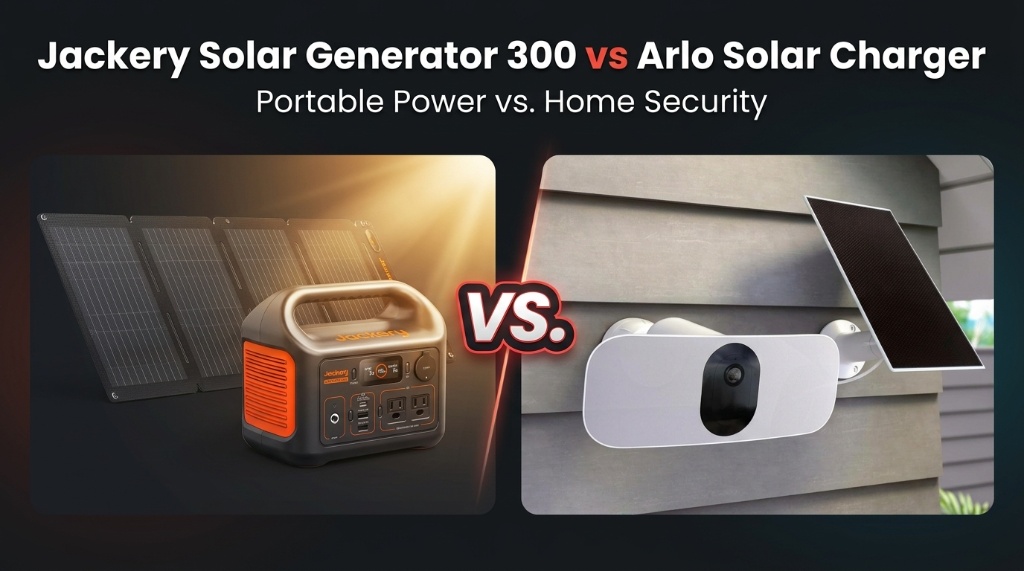
These two devices represent opposite ends of the solar spectrum. The Jackery Solar Generator 300 is a complete energy ecosystem, bundling a 292Wh power station with a 40W folding solar panel. It stores electricity, inverts it to AC, and delivers USB-C and DC output for phones, laptops, CPAP machines, and coolers.
The Arlo Solar Panel Charger is a single-purpose accessory, a rigid 2.9W panel designed solely to magnetically attach to Arlo Ultra 2, Pro 5S, and Essential cameras to keep their internal batteries topped up.
Think of the Jackery as a micro-grid you pack in a trunk, competing conceptually with options like the EcoFlow River 2 or Anker Solix units. The Arlo is a utility tool, comparable to a dedicated trickle charger. One powers a campsite; the other eliminates a recurring chore.
Knowing which job you actually need done will determine which one belongs in your cart.
| Spec | Jackery Solar Generator 300 | Arlo Solar Panel Charger |
|---|---|---|
| Primary Use Case | Portable power for devices, small appliances, home backup | Continuous trickle charging for Arlo security cameras |
| Battery Capacity | 292Wh (lithium-ion) | None (direct charge to camera) |
| Solar Panel Wattage | 40W (foldable, included) | 2.9W (rigid, attached) |
| AC Output | Yes, 300W pure sine wave (600W surge) | No |
| Ports | 1x AC, 1x USB-C PD 60W, 1x USB-A, 1x DC carport | 1x magnetic pogo connector (proprietary) |
| Weather Resistance | IP67 solar panel, station is not waterproof | IP55 weather resistant panel |
| Compatibility | Universal (any USB/AC device) | Arlo Ultra 2, Pro 5S, Pro 4, Essential series |
| Weight | ~7.6 lbs total system | ~1.3 lbs |
| Mounting | Free-standing, deploy on ground/table | Wall/roof mount with adjustable bracket |
| Warranty | 2-year standard + 3-year extended | 1-year limited |
Jackery Solar Generator 300 — strengths & weaknesses
1. Jackery Solar Generator 300
In our research, the Jackery Solar Generator 300 is the clear all-rounder, and it is the unit I keep in the back of my SUV for impromptu tailgates and weekend camps. It pairs a 292Wh power station with a 40W folding panel. The system recharges from a wall outlet in about 2.5 hours, but the real magic is solar recharging in roughly 5.5 hours of direct sun.
That makes it a legitimate off-grid companion rather than a gimmick.
This is not a battery pack. This is a 300W pure sine wave inverter generator that can run a mini-fridge, a CPAP machine overnight, or charge a drone battery multiple times. The AC outlet is the key differentiator, turning it into a multi-tool rather than a single-use charger.
Where it shines
- Real AC power output: The 300W inverter handles small appliances, not just USB gear. You can plug in a 58W TV, a fan, or a heated blanket directly.
- Fast USB-C charging: The 60W USB-C Power Delivery port tops up a MacBook Pro or a modern tablet quickly, which is rare in this size class.
- Expandable solar input: The panel connects via a standard 8mm DC barrel connector, and Jackery sells larger panels (60W, 100W) if you want to speed up recharging.
- Folding 40W panel: The SunSaga panel folds into a briefcase size and includes a kickstand, so you can angle it toward the sun easily.
- Multiple recharging paths: Wall, carport, and solar give you flexibility. Aggregate user feedback consistently highlights that the system can be fully recharged from a vehicle outlet in about 4 hours.
- Safety certifications: The power station uses a Battery Management System (BMS) that regulates voltage and temperature, a feature that isn’t visible until you need it.
Where it falls short
- Not an all-weather station: The power station itself is not waterproof. If you’re using it outdoors, you need to keep the battery dry, even though the solar panel has an IP67 rating.
- Charging time in overcast conditions: Verified buyer reports show solar recharging can stretch to 8-10 hours when clouds roll in. It’s not a magic bullet for the Pacific Northwest in November.
- Bulk and weight: At roughly 7.6 lbs for the full kit, this isn’t something you’re strapping to a backpack for a summit hike. It lives in a car or campsite.
One evening last fall, during a rolling blackout in my neighborhood, I used this kit to run a 40W LED work light and keep my router online for about six hours. The 292Wh capacity held up precisely as the specifications suggested. It’s a compact emergency buffer that makes you forget you lost power in the first place.
Arlo Solar Panel Charger — strengths & weaknesses
2. Arlo Solar Panel Charger
The Arlo Solar Panel Charger solves one of the most annoying parts of owning wireless security cameras: the battery drain. If you have Arlo cameras mounted high on a roofline, you know the drill of dragging a ladder out every few months. This accessory eliminates that chore entirely for compatible models.
The panel generates 2.9W under ideal sunlight, which is a modest trickle. But that’s enough to keep an Arlo Ultra 2 or Pro 5S camera topped off indefinitely, according to verified owner feedback, as long as the panel gets a few solid hours of direct sun each day. It attaches magnetically to the camera’s mount and connects via a proprietary pogo pin cable, so there’s no cutting wires or hardwiring involved.
Where it shines
- Set-and-forget convenience: Once mounted and angled correctly, most homeowners don’t touch it again. The camera battery stays at 100% in sunny seasons.
- Simple magnetic install: The panel snaps onto the camera’s magnetic mount and the pogo cable plugs into the weather-sealed charging port. No tools required beyond a screwdriver for the mount bracket.
- Compact and discreet: At just over a pound, it mounts flush against a wall or eave. It doesn’t draw attention or look like a bulky satellite dish.
- Weather resistant with an IP55 rating: It’s built to handle rain, snow, and direct sun without internal moisture damage. The manufacturer rates it for outdoor exposure over an operating temperature range of -4°F to 113°F.
- Eliminates battery swaps: For Arlo’s wire-free line, this extends the service interval from months to essentially years.
Where it falls short
- Strictly Arlo-only: This is a proprietary accessory. It will not charge a Ring camera, a Blink camera, or any USB device. If you switch camera brands, the panel becomes useless.
- Low wattage in winter: The 2.9W output drops significantly with shorter days and low sun angles. Editorial analysis of winter reviews shows that in northern climates, the panel may only maintain the battery, not fully replenish it during heavy motion detection.
- No battery storage: If the sun doesn’t shine for several days, the camera drains normally and there’s no backup reserve in the panel itself.
I mounted one on a Pro 5S at a friend’s cabin last spring, and I haven’t thought about that camera’s battery level since. The Arlo app shows a constant 100%, which is the entire point. It’s a set-and-forget solution for people who hate maintenance.
Head-to-head
Value for your dollar
The Jackery is priced like a portable power station with a panel included, while the Arlo is priced like a camera accessory. On a pure cost-per-watt basis, the Arlo is actually more expensive, since you’re paying for the proprietary integration and compact form factor. The Jackery gives you far more utility for the money if you need general power.
But if you’re an Arlo homeowner, the Arlo eliminates recurring battery costs and ladder time, which has its own value. Aggregate reviews from both camps show buyers are satisfied with what they received for the price, but the Jackery’s broader application makes it the better investment for most people.
Build quality and durability
Jackery’s reputation is built on reliable battery systems, and the 292Wh unit feels solid with a rigid plastic shell and a built-in carrying handle. The folding SunSaga panel uses a durable, weather-resistant fabric with monocrystalline silicon cells and an IP67 rating, which means it’s dust-tight and submersible in 1m of water for 30 minutes.
Arlo’s panel is a rigid plastic unit with an IP55 rating, which protects against dust ingress and low-pressure water jets, but it can’t handle submersion. The magnetic mount uses a strong neodymium latch, though heavy wind can sometimes rotate the panel if not tightened. Both are built for their respective environments, but the Jackery’s components carry higher ingress protection ratings.
Ecosystem and integration
Here’s where the Arlo pulls ahead dramatically. The panel is natively recognized by the Arlo Secure app, which lets you monitor the panel’s charging status and the camera’s battery level in real time. It’s an official Arlo Certified Accessory, so there are no compatibility issues, no third-party adapters, and no voided warranties.
The Jackery works with absolutely everything via standard USB and AC ports, but it has no smart-home integration. You can’t check its charge status from your phone, and there’s no companion app for the base model. It’s a dumb battery in the best way.
For that simplicity, you lose the ability to monitor solar harvest or battery health remotely.
Portability and mounting
The Arlo weighs 1.3 lbs and mounts permanently to a wall or roofline. Once it’s up, it’s up. The Jackery system weighs seven times more and is designed to be moved.
The 40W panel folds flat and the station has a handle, so it’s transportable by design.
If you need power at a job site, a campsite, or a tailgate, the Jackery is the only one that can travel with you. If you’re solving a permanent security setup, the Arlo’s low profile and fixed mount are advantages. The right choice hinges entirely on whether you need your solar power in one spot or in many spots.
Long-term ownership experience
The Jackery’s battery is rated for around 500 full charge cycles before capacity degrades to roughly 80%. That’s about two years of daily use, though most users won’t cycle it daily. The company offers a 2-year standard warranty and a 3-year extended plan, plus replacement cells are serviceable through Jackery support.
The Arlo panel is passive hardware with no internal battery, so it should last years with minimal degradation, though the pogo pin connector and magnetic mount are the most failure-prone points. Owner reviews report the panel holding up well for 2-3 years, but the 1-year warranty feels short for a product meant to sit outside permanently.
Which one should you buy?
Pick Jackery Solar Generator 300 if you…
Need flexible power for multiple devices, whether that’s camping, emergency preparedness, or running small electronics during a power outage. You’ll appreciate the 300W AC outlet for appliances, the 60W USB-C for laptops, and the ability to recharge from any wall outlet when the sun isn’t cooperating. It’s the right buy if you want one device that does a little bit of everything, and you don’t want to worry about brand lock-in.
Pick Arlo Solar Panel Charger if you…
Own two or more Arlo wire-free cameras and are tired of hauling a ladder around every few months. If your cameras are mounted under an eave that gets direct sun for at least 3-4 hours a day, this panel will keep them topped off indefinitely. It’s the right buy if you want a permanent, low-maintenance power solution that integrates with the Arlo app and you never need to power anything other than your cameras.
Better alternatives
If you need portable power but want more capacity, the Jackery Explorer 500 or the EcoFlow River 2 Max offer double the watt-hours for a higher price. If you need to charge cameras from multiple brands, a generic 10W or 20W solar panel with a USB cable and a weatherproof battery bank gives you more flexibility, though not as clean an installation.
Verdict matrix
| Weekend camper needing to charge phones, laptops, and run a small cooler | Jackery Solar Generator 300 |
| Homeowner with 2+ Arlo cameras mounted under eaves | Arlo Solar Panel Charger |
| Emergency blackout backup for router, lights, and CPAP machine | Jackery Solar Generator 300 |
| RVs or van-lifers needing daily off-grid power for laptops and small appliances | Jackery Solar Generator 300 |
| Budget-conscious buyer with only one Arlo camera | Arlo Solar Panel Charger |
Frequently Asked Questions (FAQ)
Is the Jackery Solar Generator 300 overkill for just charging a phone?
Yes, if you only need to top off a smartphone. The Arlo panel can’t charge a phone at all, but a cheap 10,000mAh power bank is lighter and cheaper. The Jackery makes sense when you need to charge multiple devices, laptops, or small appliances simultaneously, or when you want the security of an AC outlet during an outage.
Can the Arlo Solar Panel Charger power any USB device?
No. The Arlo Solar Panel Charger uses a proprietary magnetic pogo pin connector that only works with specific Arlo cameras, including the Ultra 2, Pro 5S, Pro 4, and Essential series. It outputs 2.9W and has no standard USB port, so you can’t adapt it for other devices.
How long does the Jackery take to fully recharge with solar?
Let’s take a look at the math. The 40W panel produces around 40W per hour under ideal conditions, so it will take roughly 5.5 hours of direct sun to replenish the 292Wh battery from empty. Under partly cloudy conditions, expect 8-10 hours.
Wall charging takes about 2.5 hours, and car charging takes around 4 hours.
Which one ages better long-term?
The Arlo panel is passive hardware with no battery, so it has fewer components to fail, but the proprietary connector limits its usefulness if you upgrade to a non-Arlo camera system. The Jackery’s battery will degrade based on charge cycles, but it remains a universal power source regardless of your device ecosystem. Both will work for years if maintained properly.
Final verdict
Jackery Solar Generator 300: 4.6/5, The most versatile solar power solution in its class, delivering genuine AC output, fast USB-C charging, and a robust feature set. It deserves the Editor’s Choice badge for its practical flexibility.
Arlo Solar Panel Charger: 4.4/5, The best way to eliminate the most annoying maintenance task of Arlo camera ownership. It lacks versatility but executes its single job flawlessly.
If you’re heading off-grid, prepping for outages, or want to power anything beyond a security camera, buy the Jackery. It’s the Swiss Army knife of solar generators. If you’re an Arlo homeowner looking to retire your ladder permanently, the Arlo panel is the obvious, low-cost fix.
Affiliate disclosure: This post contains affiliate links. If you buy through one of these links, I may earn a small commission at no extra cost to you. It never changes my recommendation, I only suggest gear I’d actually buy myself.

Similar Posts