Eco-Friendly Party Plates & Cutlery: A Buying Guide

You’ve done it dozens of times by now. You’re staring at a cart full of “eco-friendly” party supplies, trying to figure out if you’re actually helping the planet or just paying more for the same waste. The labels all say compostable, biodegradable, plant-based.
But what do those words really mean when the party ends?
The truth about sustainable party plates cups and cutlery is messy. As of 2026, the market is flooded with greenwashed products that sound great in the store but fall apart in reality. Our research shows that most “compostable” plastic items never actually make it to a composting facility.
They end up in landfills, where they behave just like the regular plastic they’re meant to replace.
Why Your “Eco-Friendly” Party Tableware Might Be a Lie
The compostable myth is the single biggest trap in this entire category. It’s not that these products are inherently bad. It’s that the system around them isn’t ready for them.
Here’s what happens: You buy a pack of PLA cups made from corn. You use them at your party. You toss them in the trash because you don’t have a backyard compost bin.
They go to a landfill, get buried, and sit there for decades. PLA needs temperatures above 140°F to break down. A landfill doesn’t reach those temperatures.
So it just sits there, looking like a cup, acting like plastic.
Manufacturer specifications confirm that PLA and other compostable bioplastics only degrade in industrial composting facilities. These are massive, carefully controlled sites with specialized equipment. Most cities don’t have them.
Most garbage services don’t use them. Unless you’ve explicitly confirmed your local facility handles compostable plastics, you’re almost certainly sending them to a landfill.
The same problem applies to coated paper cups. Those thin plastic linings that keep coffee from soaking through? They make the paper nearly impossible to recycle.
The whole cup goes to trash instead.
What Actually Happens in a Landfill
Landfills are designed to prevent decomposition. They seal off waste from air, light, and moisture to reduce methane emissions. That means even simple paper plates can take decades to break down once buried.
It’s a storage problem, not a disposal solution.
So when a product claims to be “biodegradable,” ask yourself: biodegradable under what conditions? In what timeframe? Most labels leave those details conveniently vague.
The Quick Answer: How to Choose Sustainably Without Losing Your Mind
The most sustainable option is always your regular dishes. Reusable plates, cups, and forks have the lowest environmental footprint even after accounting for washing them. Our research shows the water and energy used to clean them still beats the manufacturing, shipping, and disposal of any single-use alternative.
If you can’t use your own dishes, rent.
For events with 50 or more guests, rental companies will deliver, set up, and pick up everything. It costs less than most people expect and eliminates waste entirely. For smaller gatherings, buy uncoated paper plates and wooden cutlery.
Then make sure they actually get composted or properly recycled.
Avoid PLA, avoid coated paper, avoid anything that looks like plastic but claims to be better.
The Hierarchy of Green Party Tableware
Think of it as a decision tree. Start at the top and work your way down.
- Always best: Your own dishes and silverware. Zero waste, zero cost, zero guilt.
- Second choice: Rented tableware for large events. Everything gets washed and reused.
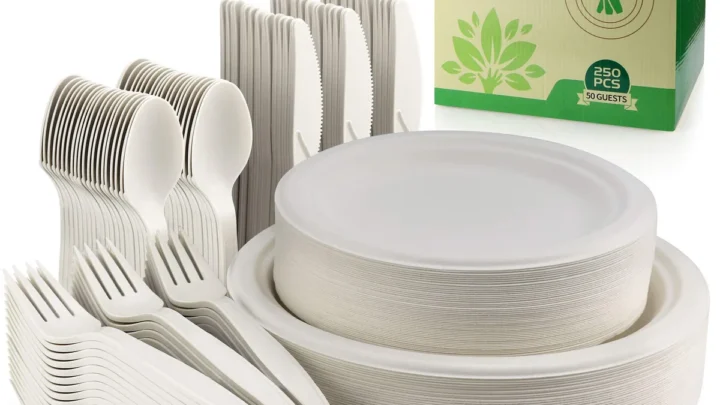
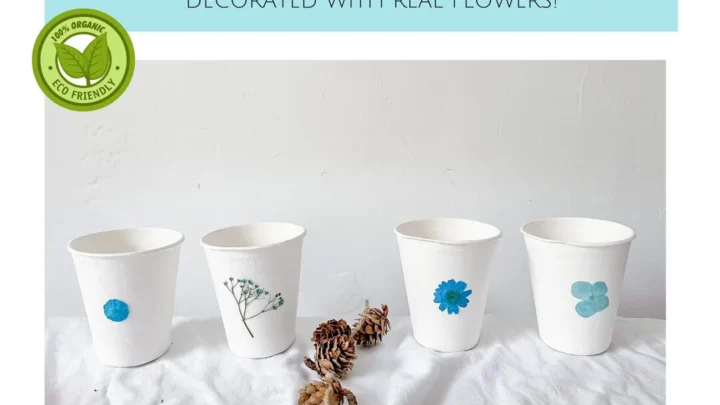
- Third choice: Uncoated paper plates, wooden or bamboo cutlery, and uncoated paper cups. All can be composted at home or sent to industrial facilities.
- Avoid entirely: PLA cups and utensils, coated paper cups, plastic-plastic hybrids, and any product with vague “eco-friendly” claims.
Every Material, Ranked: Paper, Bamboo, Bagasse, Palm Leaf, and PLA
Now let’s get specific. Each material has strengths, weaknesses, and a real-world disposal reality that might surprise you.
Uncoated Paper Plates
These are the workhorses of eco-conscious entertaining. They’re cheap, lightweight, and made from renewable resources. The best versions use 100% recycled paper and are processed without chlorine bleach.
Uncoated paper plates have one major weakness: moisture. Saucy foods will soak through quickly. Greasy foods will leave stains.
They’re perfect for cake, cookies, chips, and dry snacks. They’re a disaster for chili, pasta, or anything with a heavy sauce.
Disposal is straightforward. Clean paper plates can be recycled. Food-stained ones can be composted at home.
Both are better than landfill.
Bagasse (Sugarcane Fiber) Plates
Bagasse is the fibrous material left over after sugarcane is crushed for juice. It used to be burned as waste. Now it gets pressed into sturdy, leak-resistant plates.
These are significantly stronger than paper. They handle hot, wet, and greasy foods without collapsing. They’re microwave-safe and oven-safe up to around 350°F.
The texture looks natural and upscale, which makes them popular for weddings and nicer events.
Bagasse is compostable in both home and industrial settings, though it takes longer than paper. It’s also fully biodegradable if it ends up in a landfill, not that that’s the goal.
Palm Leaf Plates
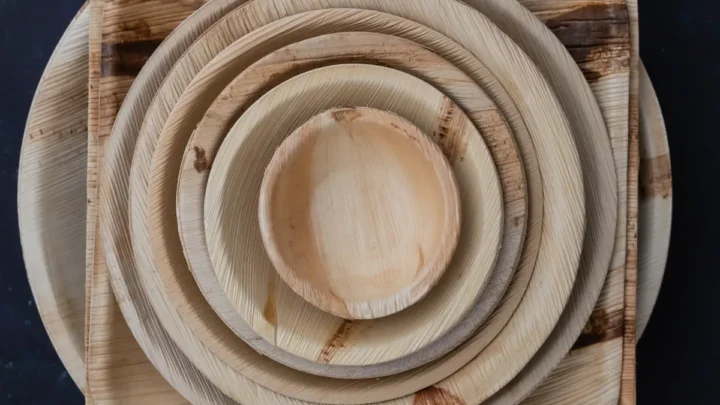
Palm leaf plates are made from fallen leaves of the Areca palm tree. The leaves are collected, cleaned, and pressed into plates using heat and pressure. No chemicals, no binding agents, no additives.
These are the sturdiest disposable plates you’ll find. They can hold heavy meals without bending or leaking. Their natural, rustic look is genuinely beautiful on a buffet table.
The tradeoff is cost. Palm leaf plates are noticeably more expensive than paper or bagasse. They’re not ideal for casual gatherings where people might toss half their food.
Home composting works, but they take longer to break down than paper.
Bamboo and Wooden Cutlery
Bamboo is arguably the best material for disposable cutlery. It’s strong, lightweight, and grows incredibly fast, making it a highly renewable resource. Wooden cutlery from birch or poplar is similar but slightly less sturdy.
Both compost at home within a few months. They don’t break apart in your hands. They won’t melt or warp like plastic.
And when they do break down, they return valuable organic matter to the soil.
The downside is minimal. They can feel slightly rough or splintery compared to plastic. Some people find the taste of wood unpleasant, though most don’t notice it.
PLA (“Compostable” Plastic)
PLA stands for polylactic acid. It’s made from fermented plant starch, usually corn. It looks and feels like traditional plastic, which is precisely the problem.
PLA is certifiably compostable under industrial conditions. Many products carry BPI (Biodegradable Products Institute) certification and meet ASTM D6400 standards. That all sounds great until you realize most households and municipalities can’t process it.

In a backyard compost pile, PLA takes years to degrade. In a landfill, it takes even longer. It’s marketed as eco-friendly, but in practice, it usually just shifts the problem from petroleum-based plastic to plant-based plastic that doesn’t degrade either.
Coated Paper and Plastic Hybrids
These are the takeout coffee cups of the world. The inside is lined with a thin plastic film to prevent leaks. That film separates the paper from recyclability.
There’s no easy way to separate the layers at home or at most recycling facilities. The entire cup goes to landfill. Even compostable-coated cups face the same infrastructure problems as PLA.
Best to avoid these entirely when you have control over supply.
Side-by-Side Comparison: Which Tableware Should You Pick?
| Material | Sturdiness | Heat Tolerance | Compostable at Home | Relative Cost |
|---|---|---|---|---|
| Uncoated Paper | Low | Low | Yes | $ |
| Bagasse | High | High | Yes | $$ |
| Palm Leaf | Very High | High | Yes (slow) | $$$ |
| Bamboo/Wood Utensils | High | High | Yes | $$ |
| PLA Plastic | Medium | Low (warp risk) | No (industrial only) | $$ |
| Coated Paper | Medium | High | No | $ |
The pattern here is clear. The materials that actually perform and actually break down are plant-based fibers, not plastic-derived resins. And the cost difference is smaller than most people assume.
Sturdiness and Heat Tolerance
If you’re serving hot, heavy, or saucy food, skip paper entirely. Bagasse and palm leaf are the only disposable options that won’t collapse under pressure. They also handle hot liquid better than PLA, which can soften and warp when exposed to high temperatures.
Uncoated paper is fine for cold and dry items. It also works for baked goods that don’t release excessive moisture.
Disposal Reality Check
Here’s the honest truth. Even the most expensive compostable plates are worthless if they end up in a landfill. The material choice matters far less than your disposal plan.
Check with your local waste management provider before buying anything. Ask if your facility accepts compostable packaging. Ask if there’s a separate organics collection program.
If the answer is no, optimize for recyclability instead.
How to Plan a Truly Green Party (Step-by-Step)
Planning a sustainable gathering doesn’t require perfection. It requires a few deliberate decisions and a basic waste station. Here’s how to do it without losing your mind.
Step 1: Run the Reusable Math
Count your guests. Estimate how many plates and forks everyone will use. For a group of 15 or fewer, just use your own dishes.
It’s cheaper, it’s easier, and it looks better.
For larger events, look into local rental services. A typical rental package includes delivery, setup, pickup, and washing. The cost is often comparable to buying premium disposable tableware.
And you’ll generate almost zero waste.
If rentals aren’t available, only then move to disposables.
Step 2: Match Material to Menu
Write down your menu first. Then choose tableware based on what you’re serving.
Dry snacks and cake? Uncoated paper plates work fine. Hearty meal with sauce?
Go with bagasse or palm leaf. Hot drinks? Use uncoated paper cups or ask guests to bring mugs.
Cold drinks? Recycled plastic cups are durable and recyclable.
Step 3: Set Up a Foolproof Waste Station
This is where most green parties fail. People want to sort correctly, but the bins are confusing and there’s no guidance.
Set up three clearly labeled bins. Compost, recycling, and landfill. Put pictures on each sign.
A bagasse plate photo goes on the compost bin. A rinsed plastic cup photo goes on the recycling bin. A chip bag photo goes on the landfill bin.
Place the station in a visible area and tell guests what goes where. You’ll get about 80% participation, which is a massive improvement over zero sorting.
Step 4: Handle Leftovers and Cleanup the Smart Way
Designate one person to manage the waste station during peak cleanup. They can quickly pull misplaced items and keep the loads uncontaminated. Scrape food scraps into the compost bin.
Stack dirty plates efficiently. Flatten cardboard and paper.
At the end of the night, you’ll have three clean loads instead of one giant trash bag. That’s a win, even if it takes a few extra minutes.
The Biggest Mistakes People Make with Sustainable Tableware
Even well-intentioned hosts get these wrong. Here’s what to avoid.
Falling for Vague Green Claims
The word “biodegradable” isn’t regulated in the same way as “organic” or “USDA certified.” A product can claim to be biodegradable and still take centuries to break down. Per the FTC Green Guides, marketers must substantiate environmental claims with evidence. Aggregated customer reviews report widespread frustration with products that don’t meet expectations.
If a label only says “eco-friendly” or “green” without specifics, it’s marketing noise. Look for concrete language like “100% recycled content” or “BPI certified compostable.”
Contaminating the Compost or Recycling Bin
A single plastic-coated cup can ruin an entire compost batch at an industrial facility. The same applies to recycling loads contaminated with greasy paper plates.
When in doubt, put it in the landfill bin. It’s better to waste one item than to contaminate an entire load.
Buying the Wrong Material for Hot or Saucy Foods
Using flimsy paper plates for wet food is a recipe for disaster. The plate collapses, food ends up everywhere, and your “sustainable” option creates more mess than a plastic one would have. Match the material to the meal, and you’ll avoid the entire problem.
How to Plan a Truly Green Party (Step-by-Step)
Planning a sustainable gathering doesn't require perfection. It requires a few deliberate decisions and a basic waste station. Here's how to do it without losing your mind.
Step 1: Run the Reusable Math
Count your guests. Estimate how many plates and forks everyone will use. For a group of 15 or fewer, just use your own dishes.
It's cheaper, it's easier, and it looks better.
For larger events, look into local rental services. A typical rental package includes delivery, setup, pickup, and washing. The cost is often comparable to buying premium disposable tableware.
And you'll generate almost zero waste.
If rentals aren't available, only then move to disposables.
Step 2: Match Material to Menu
Write down your menu first. Then choose tableware based on what you're serving.
Dry snacks and cake? Uncoated paper plates work fine. Hearty meal with sauce?
Go with bagasse or palm leaf. Hot drinks? Use uncoated paper cups or ask guests to bring mugs.
Cold drinks? Recycled plastic cups are durable and recyclable.
Step 3: Set Up a Foolproof Waste Station
This is where most green parties fail. People want to sort correctly, but the bins are confusing and there's no guidance.
Set up three clearly labeled bins. Compost, recycling, and landfill. Put pictures on each sign.
A bagasse plate photo goes on the compost bin. A rinsed plastic cup photo goes on the recycling bin. A chip bag photo goes on the landfill bin.
Place the station in a visible area and tell guests what goes where. You'll get about 80% participation, which is a massive improvement over zero sorting.
Step 4: Handle Leftovers and Cleanup the Smart Way
Designate one person to manage the waste station during peak cleanup. They can quickly pull misplaced items and keep the loads uncontaminated. Scrape food scraps into the compost bin.
Stack dirty plates efficiently. Flatten cardboard and paper.
At the end of the night, you'll have three clean loads instead of one giant trash bag. That's a win, even if it takes a few extra minutes.
The Biggest Mistakes People Make with Sustainable Tableware
Even well-intentioned hosts get these wrong. Here's what to avoid.
Falling for Vague Green Claims
The word "biodegradable" isn't regulated like "organic" or "USDA certified." A product can claim to be biodegradable and still take centuries to break down. Per the FTC Green Guides, marketers must substantiate environmental claims with evidence.
Aggregated customer reviews report widespread frustration with products that don't meet expectations. If a label only says "eco-friendly" or "green" without specifics, it's marketing noise. Look for concrete language like "100% recycled content" or "BPI certified compostable."
Contaminating the Compost or Recycling Bin
A single plastic-coated cup can ruin an entire compost batch at an industrial facility. The same applies to recycling loads contaminated with greasy paper plates.
When in doubt, put it in the landfill bin. It's better to waste one item than to contaminate an entire load.
Buying the Wrong Material for Hot or Saucy Foods
Using flimsy paper plates for wet food is a recipe for disaster. The plate collapses, food ends up everywhere, and your "sustainable" option creates more mess than a plastic one would have. Match the material to the meal, and you'll avoid the entire problem.
Frequently Asked Questions
Are compostable plates safe for hot food?
Yes, but it depends on the material. Bagasse and palm leaf plates handle hot, saucy foods without issue. Uncoated paper plates will soak through quickly.
PLA plastic can warp or soften when exposed to high heat. For soups and stews, stick with bagasse or palm leaf. For dry snacks, paper is fine.
Can I recycle pizza-stained paper plates?
No. Food-contaminated paper cannot be recycled. The grease and residue contaminate the recycling stream and can ruin an entire batch.
If the plate has food on it, compost it or put it in the landfill bin. Only clean, dry paper belongs in recycling.
Is bamboo tableware worth the higher cost?
For cutlery, yes. Bamboo forks and spoons are sturdy, renewable, and home compostable. They cost more than plastic but far less than most people expect per piece.
For plates, bamboo is less common and often pricier than bagasse. If you're on a budget, prioritize bamboo cutlery and bagasse plates.
Do compostable cups really break down in a backyard compost pile?
Most don't. PLA cups require industrial composting temperatures above 140°F. A backyard pile rarely reaches those levels.
Uncoated paper cups and wooden cups will break down at home, but they're less common. Check the label for "home compostable" specifically. If it only says "compostable," assume it needs industrial processing.
What's the cheapest way to host a green event?
Use your own dishes. It's free. For larger events, rent tableware from a local service.
If you must buy disposables, uncoated paper plates and wooden cutlery from a warehouse store offer the lowest cost per piece. Skip anything labeled "premium" or "plant-based plastic." Those are the most expensive and least eco-friendly options.
Final Verdict: What to Buy for Your Next Party
There's no single perfect product. The right choice depends on your event size, your menu, and your local disposal options.
For small gatherings, use your own dishes. For large events, rent. For everything in between, buy uncoated paper plates, bagasse plates, and bamboo cutlery.
Skip PLA and coated paper entirely.
The greenest tableware is the stuff you already own. Second best is anything that actually gets composted. Everything else is just marketing.
Plan ahead, match your materials to your menu, and set up a proper waste station. Your guests will follow your lead. And you'll throw a party that's genuinely easier on the planet, not just labeled that way.

Similar Posts